How PRX vs G2 at VALORANT Champions Shanghai became the group stage match nobody skipped in 2026
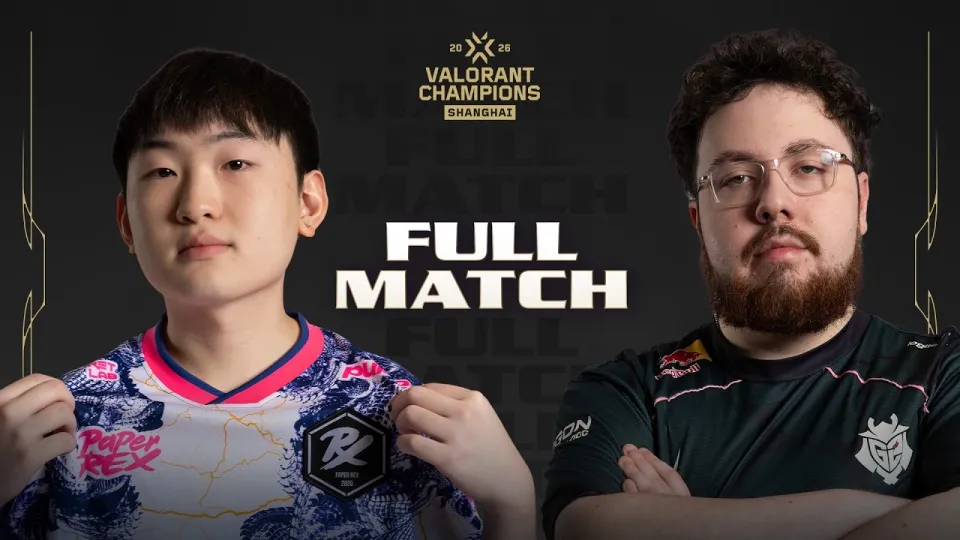
Video: PRX vs. G2 — FULL MATCH — VALORANT Champions Shanghai — Group Stage
You can order the same kind of articles for your own video to boost it on YouTube and Google. Just message the Telegram bot @sat_sit_bot. Articles with your video embedded are written and posted by the bot itself — on popular topical sites (no ads). Your first 50 articles are free.
· based on the channel VALORANT Champions Tour
Key takeaways
- PRX vs G2 was a full group stage match at VALORANT Champions Shanghai, published on the VALORANT Champions Tour channel on 29.09.2026.
- Shanghai runs from September 24 to October 18, with sixteen teams from Americas, CN, EMEA and Pacific fighting for the 2026 world title.
- The series went the distance across three maps, with Haven, Split and a decisive third map shaping the result.
- d4v41 carried PRX on Haven, Trent looked close to a perfect player on Split, and Invy popped off on the third map.
- Viewer threads focused on Something's mid-series mistakes, an Odin purchase, a possible audio cut and a brief on-screen glimpse of Vitality and LOUD.
PRX vs G2 at VALORANT Champions Shanghai is the group stage series that the VALORANT Champions Tour published in full on its YouTube channel, and it is worth watching because it packages a three-map thriller into one sitting: Paper Rex's chaos versus G2's structure, with Haven, Split and a swingy decider deciding who walked away with the group stage points. For live updates, schedules and clips from the event, the official VALORANT Esports account on X is the fastest hub: VALORANT Esports on X. The match landed on 29.09.2026, in the middle of a Shanghai run that started on September 24 and closes on October 18.
What PRX vs G2 in the VALORANT Champions Shanghai group stage actually decided
A group stage match at an international VALORANT event is never just a scoreline; it sets the map pool, the seeding and the mental state for everything that follows. Shanghai gathered sixteen teams from Americas, CN, EMEA and Pacific, and the group stage is where the bracket for the playoff run is effectively written. PRX versus G2 mattered because both rosters arrived with different identities: Paper Rex as the aggressive, tempo-first side that forces opponents into uncomfortable duels, and G2 as the disciplined, utility-heavy team that wants to slow the game down and punish overextension.
The full broadcast runs long, which is why the VCT channel published it as a complete match rather than a highlight reel. Watching the whole thing reveals the small decisions that a recap hides: the pistol rounds, the save buys, the mid-round calls that flip a 3v5 into a retake, and the economy spirals that follow a lost bonus. Those are the moments that decide group stage standings in a sixteen-team field where one map can be the difference between an upper bracket path and an elimination match.
Map one on Haven and why d4v41 became the talking point
Haven is the map that rewards teams willing to play the A-long and C-long flanks simultaneously, and it is where Paper Rex's star rifler d4v41 put together the kind of performance that carries a roster through a rough half. Viewers repeatedly pointed to him as the player holding PRX together on Haven, and the numbers behind that impression are easy to see in the full match: multi-kill rounds on retakes, opening duels won on the long angles, and utility used to isolate G2's anchor players instead of simply burning it for entry.
For G2, the Haven half was about damage control. The team's default structure — slow map control, then a mid-round collapse onto a site — works best when the opponent's aggression can be read. PRX's unpredictability makes that reading expensive. Three things decided Haven:
- Pistol round conversion and the follow-up bonus, which set the early economy for both sides.
- Mid control on the window and garage areas, which dictated which site PRX could hit without walking into a crossfire.
- Post-plant positioning, where G2's retakes were repeatedly cut off by PRX's flank timing.
Split and the Trent question
Split is the map where a single player can look flawless, and Trent's performance there drew exactly that reaction from viewers who described him as looking like a perfect player. Split's verticality — the ropes, the mid vents, the tight B-main choke — rewards players who understand when to take space and when to give it up, and Trent's rounds on that map were built on clean crosshair placement and disciplined utility usage rather than highlight-reel gambles.
The map also exposed the contrast between the two teams' philosophies. Where PRX tends to flood a site and force the retake, G2 prefers to trade space for information and then collapse. On Split, that meant long, grinding rounds where the first blood often decided the pace of the entire round. If you are studying the series for improvement rather than entertainment, Split is the map to rewatch at half speed: the setups on both sides are textbook examples of how to play the map's mid control without overcommitting.
The decider, Invy's pop-off and the Something debate
The third map is where the series turned into a genuine back-and-forth, and it is the part of the broadcast that generated the most viewer discussion. Invy's performance on the decider was called out as the standout of the night — the kind of round-swinging output that turns a close map into a won map. At the same time, PRX fans spent the match on edge, and a large share of that anxiety was directed at Something, whose mid-series mistakes and one costly moment late in the decider became the most-referenced talking point in the comments.
It is worth being fair here. Something's role on PRX is one of the hardest in professional VALORANT: he is expected to open rounds, absorb the first trade, and still produce in clutch situations. When that role works, it looks effortless; when it fails, it looks like throwing. The full match shows both sides of that coin, including the rounds where his pressure created the space that d4v41 and Invy converted into kills.
Common viewer questions about this match
A few themes kept coming up in the comment section, and they are worth addressing directly rather than leaving as speculation.
- The Odin purchase. A heavy-machine-gun buy in a professional match always sparks debate. In practice, the Odin is a situational tool: it is strong for holding a choke point, breaking a stacked site, or forcing enemies out of a smoke. It is not a default buy, and it usually signals a specific read on how the opponent is playing a position.
- The audio cut. Viewers flagged a moment where the broadcast audio appeared to drop out. Live esports broadcasts occasionally lose a feed or a commentator channel for a few seconds; the full VOD is the best way to confirm whether anything was actually missed or whether it was a local playback issue.
- The Vitality and LOUD screens. A brief glimpse of other teams' logos on the venue screens caused some confusion. Arena screens at international events cycle through promotional and bracket graphics for the whole tournament, so seeing teams that are not currently playing is normal production behaviour, not a spoiler or a mistake.
- The spoiler shield. The most-liked comment on the VOD is a spoiler warning, which tells you everything about how tense this series was. If you plan to watch it, avoid the comment section until you are done.
Why this series is a useful watch for improving players
Beyond the entertainment value, PRX vs G2 is a compact lesson in how two opposite playstyles interact. Paper Rex demonstrates how to convert individual mechanics into team tempo: fast entries, aggressive flanks, and a willingness to take fights that most teams would decline. G2 demonstrates the counter-argument: patience, layered utility, and retakes built on information rather than reflex.
If you are reviewing the match for your own improvement, pick one map and track a single variable — for example, how each team handles the first 30 seconds of a round. You will see PRX commit early and G2 delay, and you will see how those choices cascade into the economy, the buy decisions and ultimately the score. That is a far more useful exercise than simply counting kills.
Useful links and where to follow the action
The VALORANT Champions Tour channel is the source for full matches, recaps and interviews from Shanghai, and the official social channels carry schedules, results and behind-the-scenes content:
- https://twitter.com/ValorantEsports
- https://www.facebook.com/ValorantEsports/
- https://www.instagram.com/VALORANTESPORTS/
- https://www.tiktok.com/@valorantesports
- https://www.twitch.tv/valorant
What this match leaves us with
PRX vs G2 delivered exactly what a group stage at an international VALORANT event should: three maps of contrasting styles, individual performances that swung entire maps, and a result that reshaped the standings in Shanghai. d4v41's Haven, Trent's Split and Invy's decider are the three names that define the series, while Something's rough patches remind us how unforgiving the duelist role is at this level. The full match is available on the VALORANT Champions Tour channel, which produced this broadcast and remains the best place to follow the rest of the tournament. If you want live updates, bracket information and clips as the event progresses, follow VALORANT Esports on X and keep an eye on the official channels for the next round of matches.
Questions & answers
Did PRX vs G2 at VALORANT Champions Shanghai go to three maps?
Yes. The series went the full distance, with Haven, Split and a decisive third map. Haven was defined by d4v41's carry performance for PRX, Split by Trent's near-flawless play, and the decider by Invy's standout rounds alongside a costly late mistake from Something.
Why did a player buy an Odin in a professional VALORANT match?
The Odin is a situational purchase rather than a default weapon. It is used to hold a choke point, break a stacked site, or force opponents out of smokes, and it usually signals that the team has read a specific pattern in the opponent's setup. It can look unusual, but it is a deliberate tactical choice.
Was there an audio problem during the PRX vs G2 broadcast?
Some viewers reported a brief audio dropout during the match. Short feed interruptions happen on live esports broadcasts, and rewatching the full VOD on the VALORANT Champions Tour channel is the simplest way to check whether anything was actually missed.
Why were other teams like Vitality and LOUD shown on the arena screens?
Arena screens at international events cycle through tournament-wide graphics, including promotional material and bracket information for teams that are not currently playing. It is standard production behaviour and not an indication of a spoiler or a scheduling error.
Source: PRX vs. G2 — FULL MATCH — VALORANT Champions Shanghai — Group Stage · Markdown version